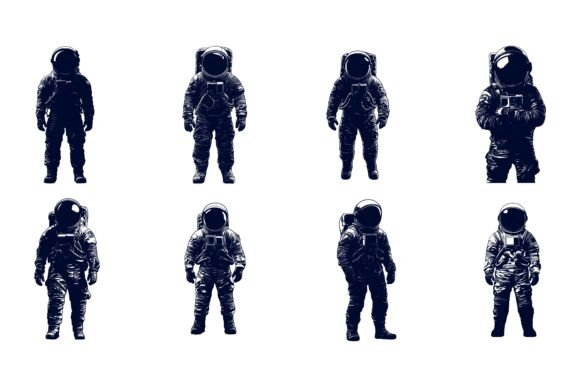
Astronaut AI EPS Illustration Set: Versatile Design Resource
An astronaut floating in space, reaching for a star or standing on a lunar surface — these images have a universal appeal. They evoke exploration, ambition, and the thrill of the unknown. Whether you are designing a tech startup pitch deck, a children’s book about planets, or a poster for a science event, a well-crafted astronaut illustration can instantly communicate your message. The challenge is finding a set that is not only visually striking but also practical to use across different media.
That is exactly where this Astronaut AI EPS illustration set comes in. Part of a carefully curated collection, it delivers a range of space-themed vector illustrations designed for both Mac and Windows users. The files are provided in AI, EPS, and JPG formats, making them accessible whether you work in Adobe Illustrator, CorelDRAW, or another compatible application. What makes this set truly special is the level of thought put into usability — from clean layer structure to easy color customization — so you can spend less time wrestling with files and more time creating.
Key Characteristics That Make This Set Stand Out
When you open the file, the first thing you notice is the organization. Layers and groups are neatly named, and elements are separated logically. No hunting through hundreds of unnamed paths. This structure is a lifesaver when you need to adjust a single element, like changing the color of the astronaut’s helmet visor or moving a star behind a planet.
The set includes vector files (AI and EPS) and a high-resolution JPG preview. Vectors mean you can scale the illustrations to billboard size without losing quality — essential for both print and digital work. The illustrations are crafted with consistency in mind: line weights, shading styles, and proportions match across all characters and objects. This coherence is crucial when you use multiple illustrations in one project, such as an infographic or an app interface.
Another standout quality is the editability. You can change colors, resize components, and modify shapes with just a few clicks. The original paths are clean, with no unnecessary points or messy curves. If you want to create a night version versus a daytime scene, or flip a pose, you can do it in minutes. The set is designed for professionals who value precision and speed.
Practical Applications Across Personal and Professional Projects
The versatility of this astronaut collection means it fits into many contexts. Here are a few realistic ways people are already using illustrations like these:
Marketing and Branding
Startups and established companies alike use space imagery to signal innovation and forward thinking. A social media campaign for a new tech product might feature an astronaut reaching for a glowing icon, symbolizing discovery. The ability to recolor the illustration to match brand guidelines — swapping NASA-blue for your own palette — makes it a practical asset. Similarly, email newsletters, landing pages, and presentation slides benefit from a cohesive visual style that the set provides.
Education and Training
Teachers and instructional designers often need engaging visuals to explain complex topics. An astronaut illustration can represent science lessons about the solar system, history lessons about space exploration, or even metaphors for personal growth. Because the set includes individual elements (like rockets, planets, stars), you can build custom infographics or worksheets. For example, an interactive e-learning module might use the astronaut as a guide character, with speech bubbles and icons added from the same set for visual consistency.
Content Creation and Blogging
Bloggers and publishers covering topics in technology, science, or productivity frequently need hero images. Instead of licensing generic stock photos, a unique vector illustration helps a site stand out. The astronaut set works beautifully as a featured image for articles about innovation, career pivots, or even personal development (think “reach for the stars”). The JPG version gives you a quick option for thumbnails, while the AI/EPS files allow you to create custom variations for social media posts.
App and Interface Design
Mobile and web apps that target a creative or exploratory audience can benefit from illustrations in the user interface. A loading screen, empty state, or onboarding flow are all natural places for an astronaut graphic. Because the vectors are clean and simplified, they scale down to small icon sizes without looking cluttered. The organized layers also make it easy to export individual elements as SVG or PNG for use in web development.
Print and Merchandise
From posters and brochures to t-shirt designs and stickers, vector illustrations are ideal for print. The high-resolution JPG offers a quick preview, but for production you will want the AI or EPS file to ensure sharp lines. The set’s attention to detail — shading, texture, and subtle highlights — translates well to larger formats. A science museum could use the astronaut on a banner, or a coffee shop could print it on a limited-edition mug.
How This Illustration Set Boosts Productivity and Consistency
One of the biggest time drains in creative work is hunting for assets that match. With this set, you get a unified visual language right out of the box. The astronaut illustrations share a common style with other elements in the collection, so you can mix and match without worrying about conflicting aesthetics. This consistency speeds up the design process, especially when working under tight deadlines.
The editability further reduces production time. Need a different background color? Double-click the layer and change it. Want to use the astronaut in a horizontal layout? Rotate and reposition elements that are already grouped. The file structure is intuitive, so even if you are not an advanced Illustrator user, you can make adjustments confidently. For teams collaborating across different software (some on Mac, some on Windows), the AI and EPS formats work universally without conversion hassles.
Another practical benefit: the set helps maintain brand identity. If you are a freelancer or agency managing multiple clients, you can quickly adapt the same astronaut base to different color schemes and contexts. That means you are not starting from scratch each time — a small investment in the set pays off in repeated reuse.
Real-World Use Cases and Observations
Consider a scenario from a recent project I worked on with a small edtech startup. They needed a mascot for their app that taught coding to kids. The astronaut became the central character, guiding users through lessons. We used the provided AI file to adjust the astronaut’s pose slightly — raising an arm to point at a button — and recolored the helmet to match the app’s blue palette. The process took under an hour because the layers were clearly labeled and the paths were clean. The startup later used the same illustration on their website, in an explainer video, and on printed classroom posters. The consistency across those touchpoints made the app feel polished and professional.
Another observation from a marketing agency: they used the set to create a series of social media posts for a science-themed month. Each post featured the astronaut in a different setting — on the moon, near a rocket, floating with planets. Because the base illustration was the same, the series had a cohesive look, but small tweaks (changing background color, adding text overlays) kept each post fresh. The agency reported that creating ten posts took only about two hours, including planning, whereas sourcing custom illustrations would have taken days.
Practical Considerations When Using the Set
Before diving in, think about the context of your project. The astronaut style has a modern, somewhat simplified vector look — clean lines, flat colors with subtle gradients. This works well for digital interfaces and contemporary print, but if your project requires hyper-realistic or vintage illustration, you may need to complement the set with other assets. That said, the simplicity is often an advantage: it stays legible at small sizes and does not distract from content.
When you first open the file, take a few minutes to explore the layer structure. Even though it is organized, each designer may prefer a different workflow. I recommend duplicating the original file and working from a copy. That way you always have the baseline to fall back on. If you plan to resize drastically (e.g., from a small icon to a large poster), check that strokes and effects scale proportionally. In Illustrator, you can use the “Scale Strokes & Effects” option to avoid inconsistencies.
Also consider the color palette. The set likely comes with default colors, but you can adapt them to your project’s scheme. For print work, ensure you convert to CMYK if needed. For web, RGB is fine. The EPS format typically preserves spot colors if you need them for branding. If you are collaborating with a team, establishing naming conventions for layers and colors upfront can save headaches later.
Finally, think about licensing. The set is intended for commercial and personal use, but always confirm the specific terms. Most illustration bundles allow you to use the assets in client projects, modify them, and even use them in templates you sell, as long as you do not redistribute the raw files. Keep a copy of the license for your records.
At the end of the day, having a high-quality, editable astronaut illustration set at your disposal is a practical step toward more efficient and visually consistent work. Whether you are a marketer building a campaign, an educator creating a lesson, or a freelancer serving multiple clients, the ability to customize and reuse these assets saves time and elevates your output. The space theme may be universal, but the way you use it is unique to your project — and this set gives you the flexibility to make it your own.