Bring Your Projects to Life with Tropical Icons and Minimalist Icon Design
In today’s fast-paced digital world, visual communication is more important than ever. Whether you are designing a website, building a mobile app, creating a book layout, or crafting a social media campaign, the icons you choose can make or break the user experience. Among the most versatile and beloved icon themes are tropical icons—vibrant, nature-inspired symbols that evoke warmth, relaxation, and adventure. When combined with a minimalist icon design approach, these icons become powerful tools that are both aesthetically pleasing and highly functional. This article explores everything you need to know about tropical icon sets, their practical applications, and why a high-quality, customizable icon collection is a must-have for any creative project.
What Are Tropical Icons and Why Do They Matter?
Tropical icons are visual symbols inspired by tropical environments: palm trees, coconuts, pineapples, flamingos, sunsets, ocean waves, exotic flowers, and other elements associated with sunny, beachy locales. They are widely used to convey a sense of escape, leisure, and natural beauty. But their appeal goes far beyond decoration. In design, tropical icons help establish a mood, reinforce branding, and guide users intuitively. For example, a travel website might use a palm tree icon to indicate a beach destination, while a wellness app could use a tropical leaf to symbolize organic ingredients.
The significance of tropical icons lies in their universal emotional resonance. Most people associate tropical imagery with positive feelings—vacation, warmth, and happiness. By incorporating these icons into your project, you tap into that emotional connection, making your content more engaging and memorable. Moreover, tropical icons are remarkably flexible. They work equally well in websites, mobile apps, books, social media posts, infographics, flyers, print materials, banners, and posters. This versatility makes them a valuable asset for designers, marketers, educators, and content creators alike.
The Rise of Minimalist Icon Design in Modern Projects
Icon design has evolved significantly over the past decade. Gone are the days of overly complex, skeuomorphic graphics that tried to mimic real-world textures. Today, the trend is toward minimalist icon design—clean, simple, and highly readable symbols that prioritize clarity and functionality. Minimalist icons use basic shapes, consistent stroke weights, and limited detail to communicate ideas instantly. This approach aligns perfectly with modern design principles such as flat design, material design, and accessible UX.
Why has minimalist icon design become so popular? First, it improves usability. Simple icons are easier to recognize at small sizes, which is critical for mobile interfaces and responsive layouts. Second, minimalist icons load faster and scale better across different screen resolutions. Third, they have a timeless quality—they don’t look dated as design trends shift. When you combine minimalist aesthetics with tropical themes, you get icons that are both evocative and practical, capable of enhancing any project without overwhelming the user.
Line Style vs. Solid Style: Two Sides of the Same Coin
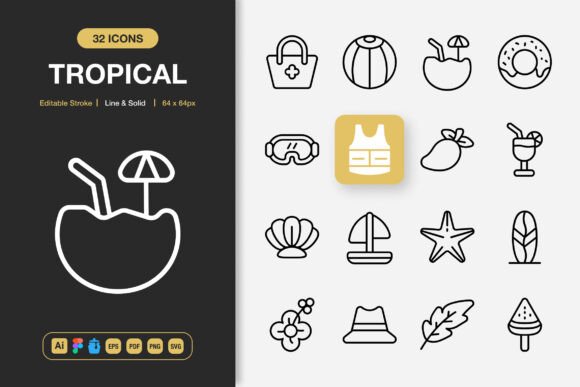
High-quality tropical icon sets typically offer two style variations: line style and solid style. Line-style icons use thin, consistent strokes to outline shapes, giving a light and open feel. They are ideal for modern interfaces where you want to maintain a clean, airy look. Solid-style icons, on the other hand, are filled with color or black, making them bolder and more prominent. They work well for emphasis, buttons, or when you want icons to stand out against busy backgrounds.
Having both styles in one set gives you incredible flexibility. You can use line icons for navigation or secondary actions, and solid icons for primary calls to action or decorative accents. For instance, in a travel booking app, you might use a solid palm tree icon for the “beach” category and a line version for the same icon in a filter menu. This consistency across styles strengthens your visual language and improves user comprehension.
Key Features of a High-Quality Tropical Icon Set
Not all icon sets are created equal. To ensure your projects look professional and function well, look for a set that includes the following features:
- Editable Stroke: Icons with editable strokes allow you to adjust the line thickness, color, and style without breaking the design. This is essential for adapting icons to different brand guidelines or interface requirements.
- High Quality: Every icon should be crafted with precision, using clean curves, consistent alignment, and proper spacing. High-quality icons look sharp at any size and reflect well on your brand.
- 100% Customizable: The best icon sets are fully customizable, meaning you can change colors, resize, rotate, or combine elements freely. This is especially important when you need to match a specific color palette or create unique variations.
- Easy Drag and Drop: A well-organized icon set lets you drag and drop files directly into your design software, saving time and reducing friction in your workflow.
When an icon set includes these features, it becomes much more than a collection of graphics—it becomes a design system that you can rely on for years.
File Formats That Work Everywhere
One of the most practical aspects of a premium icon set is the range of file formats included. Different projects require different formats, and having them all in one place eliminates the need for conversion or re-downloading. Look for a set that includes:
- Source File Adobe Illustrator (.ai): The native vector format for Illustrator, giving you full access to paths, layers, and effects.
- Figma File: Essential for teams working in Figma, allowing seamless collaboration and integration with your existing design system.
- Iconjar File: A convenient way to manage and preview your icon library on macOS.
- EPS Version 10: A widely compatible vector format that works with many design applications.
- PDF File: Useful for presentations, documentation, and print proofs.
- SVG File: The standard for web and app development—SVGs are scalable, lightweight, and maintain crispness on retina displays.
- PNG Transparency (32px, 48px, 64px, 96px, 128px, 256px, 512px): Pre-rendered raster images at common sizes, ready for use in web, mobile, and print without any extra work. The transparent backgrounds make them easy to place on any color or image.
- Readme.txt: A simple text file with usage notes, licensing info, and helpful tips.
Having this breadth of formats ensures that whether you’re a web developer needing SVG code, a print designer requiring EPS files, or a social media manager grabbing PNGs, everything is at your fingertips.
Practical Applications: Where to Use Tropical Icons
Tropical icons are far more than just decorative elements. They can be integrated into almost every type of project to improve communication and visual appeal. Below are some of the most effective use cases:
Websites
On websites, tropical icons can serve as navigation aids, feature highlights, or section dividers. For a travel blog, a line-style coconut icon next to a “beach resorts” category adds visual interest and helps users find content faster. For an e-commerce site selling summer products, solid-style icons can draw attention to sales or special offers.
Mobile Apps
Mobile interfaces demand clarity at small sizes. Minimalist tropical icons, especially in line style, work beautifully for tab bars, toolbars, and buttons. An app for outdoor activities might use a wave icon for “surfing” and a sun icon for “weather,” making the interface intuitive even for first-time users.
Books and E-books
In print or digital books, icons can break up text and illustrate concepts. A cookbook with tropical recipes could use small pineapple icons to mark vegetarian dishes, or a travel guide might use a hibiscus flower to denote local tips. Icons add a professional touch without the cost of custom photography.
Social Media
Social media posts that use icons tend to get higher engagement because they are visually scannable. A tropical icon set can help you create themed content for summer promotions, giveaways, or brand storytelling. Use solid-style icons in story highlights or as overlays on photos to maintain a consistent look.
Infographics
Infographics rely on visual elements to convey data quickly. Tropical icons can represent statistics—for example, a palm tree could indicate “number of beach destinations,” while a wave icon could show “ocean temperature.” This makes your infographic more engaging and easier to understand.
Flyers, Banners, and Posters
Printed materials benefit from high-resolution PNGs or vector EPS files. A tropical-themed flyer for a resort or a summer sale can use large solid-style icons as focal points, while smaller line icons add detail without clutter. Banners and posters with tropical icons instantly communicate a mood and attract attention.
How to Choose the Right Icon Set for Your Project
With so many options available, selecting the perfect tropical icon set can feel overwhelming. Here are a few criteria to guide your decision:
- Consistency of Style: Ensure all icons in the set share the same stroke weight, corner radius, and visual proportion. Mixed styles look unprofessional.
- Completeness of the Set: Look for a set that includes all the icons you need for your specific project. A good set should cover common tropical subjects like plants, animals, weather, activities, and symbols.
- File Format Availability: Match the file formats to your workflow. If you use Figma, a Figma file is a must. If you develop websites, SVG support is critical.
- Customization Options: Check whether the icons have editable strokes and are fully customizable. This will save you time when adapting them to different brands.
- Licensing and Support: Read the Readme.txt or license file to understand usage rights. Good sets offer clear permissions for both personal and commercial use.
When you invest in a high-quality set that offers both line and solid styles, multiple file formats, and easy drag-and-drop functionality, you’re not just buying icons—you’re buying efficiency and peace of mind.
Common Misunderstandings About Icon Sets
Some designers assume that all icon sets are essentially the same, or that free icons are sufficient for professional work. While free icons can be useful for mockups or personal projects, they often lack consistency, scalability, and legal clarity. Premium sets, like the one described in this article, are crafted by professionals who ensure every icon meets a high standard. Another misconception is that minimalist icons are boring or lack personality. On the contrary, a well-designed minimalist tropical icon can convey warmth and playfulness through subtle curves and thoughtful proportions.
The Future of Icon Design: Minimalism Meets Meaning
As digital interfaces continue to evolve, the demand for minimalist icon design will only grow. Users expect fast, intuitive experiences, and icons play a huge role in delivering that. Tropical icons, with their universal appeal and positive emotional associations, are perfectly positioned to meet this demand. Whether you’re designing for a global brand or a local business, a set of high-quality tropical icons can elevate your work and connect with audiences on a deeper level.
The combination of line and solid styles, editable strokes, and comprehensive file support makes a premium icon set an indispensable resource. You can use the same set for a mobile app, a printed brochure, a social media campaign, and a website—saving time, ensuring consistency, and improving the overall quality of your output.
Final Thoughts
If you are ready to transform your next project, consider investing in a top-tier tropical icon set that features minimalist design, full customization, and a wide range of formats. The ability to drag and drop files, adjust colors and strokes, and instantly access PNGs at multiple resolutions will streamline your workflow and impress your clients or audience. With the right icons, you can communicate ideas clearly, evoke the right emotions, and create a cohesive visual experience across every platform.
Remember, the best icons are the ones that disappear into the background—serving their purpose without calling attention to themselves. Minimalist tropical icons do exactly that. They add clarity, warmth, and beauty to any project, making your work stand out in a crowded digital landscape. Choose wisely, and your users will thank you.
Thanks for reading, and we hope you found this guide helpful for your next creative endeavor.