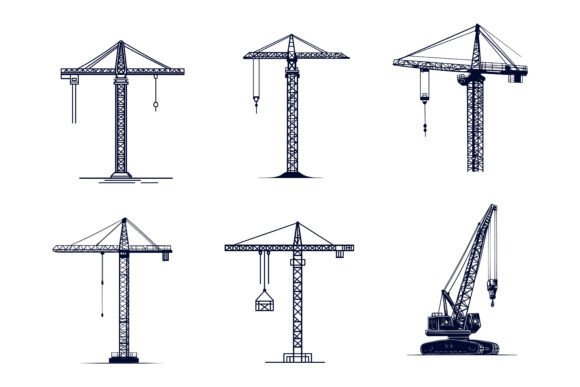
Different Tower Cranes: Essential Equipment Visualized Through Professional AI EPS Illustrations
In the modern construction landscape, few pieces of equipment are as recognizable or as structurally critical as the tower crane. Yet, for all their ubiquity on job sites around the world, the nuances that differentiate one type of tower crane from another often remain the domain of seasoned project managers and equipment specialists. Understanding these distinctions is not merely an academic exercise. It shapes decisions about site logistics, lifting capacity, assembly methods, and ultimately, project timelines and budgets. At the same time, communicating these complex variations to clients, stakeholders, or students requires visual assets that are precise, scalable, and adaptable. This is where a purpose-built collection—like the Different Tower Cranes AI EPS illustration set—becomes an indispensable resource for anyone working in or around the built environment.
This article examines the major types of tower cranes deployed on construction sites today, explores why professionals are paying closer attention to crane selection, and demonstrates how a high-quality illustration set can elevate presentations, proposals, training materials, and marketing content. Welcome to our special AI EPS collections — a carefully curated set designed to meet the visual communication needs of construction professionals, architects, trainers, and creatives alike.
What Are the Different Types of Tower Cranes and Why Do They Matter?
Tower cranes are broadly categorized by their mounting method, structural configuration, and slewing mechanism. Each configuration serves a specific set of site conditions, load requirements, and spatial constraints. The three primary categories that dominate the industry are hammerhead cranes, luffing jib cranes, and self-erecting cranes. Each of these has sub-variants that further tailor performance to project needs.
Hammerhead Tower Cranes
The hammerhead crane—also known as a top-slewing crane with a horizontal jib—is the most iconic silhouette on skylines worldwide. Its jib remains horizontal throughout operation, and the trolley moves along the jib to position the load. This design offers a consistent hook radius and excellent coverage for large, open sites such as high-rise residential towers, commercial complexes, and industrial facilities. Hammerhead cranes can be fixed to a concrete foundation, climbed internally as the building rises, or mounted on a travelling chassis for rail-bound movement.
For professionals who need to illustrate site layouts or crane placement strategies, the hammerhead crane’s distinctive profile must be rendered with geometric accuracy. The Different Tower Cranes AI EPS collection includes detailed variants of hammerhead cranes with clear articulation of the mast, jib, cab, and counter-jib. This level of detail supports clear communication with architects, engineers, and safety inspectors.
Luffing Jib Tower Cranes
Luffing jib cranes differ from hammerhead models in a fundamental way: the jib can pivot vertically, or “luff,” to change the working radius. This is a decisive advantage in dense urban environments where multiple cranes operate in close proximity, or where the site is hemmed in by existing structures. By raising the jib, the crane can operate within a tighter slewing arc, reducing the risk of collision and allowing work to proceed on congested sites. Luffing jib cranes are also favored for projects with stringent height restrictions during certain phases of construction.
Because the luffing mechanism introduces additional mechanical complexity, visual aids that show the jib in both horizontal and raised positions are extremely helpful for operator training and lift planning. The illustration set provides multiple poses of luffing jib cranes, allowing trainers and safety officers to demonstrate clearance zones, load paths, and operational limits without relying on ambiguous diagrams.
Self-Erecting Tower Cranes
Self-erecting cranes bring a unique value proposition: they can be transported to site on a single trailer and erected without the need for a separate mobile crane. They typically feature a folding mast and jib that rise into position using hydraulic or electric systems. These cranes are ideal for smaller projects, townhouse developments, low-rise commercial buildings, and infrastructure maintenance tasks. Their rapid setup and takedown times translate directly into cost savings and schedule flexibility.
From a visual communication standpoint, self-erecting cranes present a different set of design challenges. Their compact, folding geometry requires illustrations that show both the transport configuration and the operational state. The Different Tower Cranes collection includes these transitional states, making it easier for equipment dealers, rental companies, and project planners to explain the setup sequence to clients and site crews.
The Broader Trends Driving Attention to Tower Crane Selection
Interest in crane types and specifications is not occurring in a vacuum. Several intersecting developments across construction, technology, and workforce management are elevating the importance of accurate, visually clear crane information.
Urban Densification and Constrained Sites
As cities grow denser, construction sites become tighter and more irregular. The luxury of a wide, unobstructed site is increasingly rare. Tower cranes must work within property lines, near existing buildings, and above active public spaces. This pushes project teams to analyze crane geometry, slew circles, and tail swing with far greater precision than in previous decades. Luffing jib cranes, in particular, have gained popularity because their variable jib angle helps them fit into tight airspace. When professionals need to communicate these spatial constraints to non-technical stakeholders—such as city planning boards or community groups—high-quality illustrations that accurately depict crane dimensions and movements become essential.
Modular Construction and Heavier Prefabrication
The shift toward modular and off-site construction means that individual components—bathroom pods, structural steel assemblies, prefabricated facades—are heavier and larger than traditional stick-built elements. Tower cranes must be selected based on exact load charts, lifting radii, and capacity curves. Misjudging a crane’s capacity at a given radius can halt a project or create safety hazards. Visual resources that show load radius overlays, capacity zones, and crane configurations help project engineers make informed decisions and communicate those decisions to installation crews.
Digital Workflows and Visual Documentation
Construction documentation is moving from 2D blueprints to integrated digital workflows that include Building Information Modeling (BIM), lift studies, and site logistics plans. Yet, even in a digital environment, there is consistent demand for clean, editable vector illustrations that can be inserted into reports, presentations, and training modules. The Welcome to our Special AI EPS Collections directly addresses this need by offering files that are compatible with both Mac and Windows systems, organized with neat layer structures, and fully editable in Adobe Illustrator. Users can change colors, adjust line weights, and modify details to match specific crane models or site conditions. This flexibility ensures that visual assets remain useful across multiple contexts—from a safety orientation booklet to a high-stakes investment pitch.
Workforce Development and Training
The construction industry faces a persistent skills gap, particularly among crane operators and riggers. Training programs must convey complex spatial and mechanical concepts to learners who may have limited field experience. Engaging visual materials that show cranes from multiple angles, in different configurations, and across various tasks improve comprehension and retention. The illustration set includes multiple views and operational states, making it a practical tool for vocational trainers, union apprenticeship programs, and equipment manufacturers who produce operator manuals.
How the Different Tower Cranes Illustration Set Meets Changing Professional Needs
The shift toward more sophisticated construction methods and tighter site constraints has changed what professionals expect from their visual tools. Generic clip art or low-resolution photographs no longer suffice when stakeholders demand precision, consistency, and brand alignment. The Different Tower Cranes AI EPS illustration set addresses these expectations in several deliberate ways.
Precision and Consistency Across Visuals
When a set of illustrations maintains consistent proportions, line quality, and perspective, the entire body of work gains credibility. This is especially important for companies that produce safety manuals, technical proposals, or marketing collateral. A single off-model crane can undermine the professionalism of an otherwise strong document. The collection is built with meticulous attention to detail, ensuring that every crane variant adheres to real-world proportions and structural logic. Users can rely on these illustrations to accurately represent equipment without needing to redraw or correct basic geometry.
Editability and Adaptability
No two construction projects are identical. A crane that works for a 30-story residential tower may need adjustments in jib length, mast height, or counterweight configuration for a mixed-use development. Because the illustration files are organized with clear layer structures, users can quickly isolate components—mast sections, jib elements, cabs, counter-jibs—and modify them independently. Changing colors to match corporate branding or site-specific markings takes seconds. This editability reduces the time spent on graphic production and allows in-house teams to produce custom visuals without outsourcing to agencies.
Multi-Format Availability
The set includes AI (Adobe Illustrator), EPS, and JPG formats, ensuring compatibility across software environments and use cases. Designers working in vector-heavy workflows can take full advantage of the AI and EPS files for scaling and printing. Meanwhile, professionals who need quick inserts for email, web pages, or internal presentations can use the JPG versions without opening a vector editor. This dual-format approach respects the diverse technical skill levels and software access found across the construction industry.
Suitable for Print, Web, Symbols, Apps, and Infographics
Modern communication channels are varied. A crane illustration might appear in a printed safety manual, a responsive web page, a mobile app for lift planning, or an animated infographic for a trade show. The vector files are resolution-independent, so they reproduce cleanly at any size. The JPG versions provide a lightweight option for digital use where vector editing is unnecessary. This versatility means that a single purchase of the illustration set can serve multiple departments and purposes across an organization.
Practical Examples: Putting the Illustration Set to Work
To understand the real-world value of this collection, consider three common scenarios where the Different Tower Cranes illustrations streamline communication and decision-making.
Scenario 1: Preparing a Lift Study for a Tight Urban Site
A structural engineer is evaluating crane options for a 14-story hotel on a narrow lot bordered by an active subway line and a heritage building. She needs to compare the slewing radius and tail swing of a luffing jib crane versus a hammerhead crane. Using the illustration set, she quickly places scaled models of both cranes onto her site plan. The clear outlines enable her to visualize clearance zones, identify potential conflicts, and present her recommendation to the client with confidence. The client, who is not an engineer, can see exactly why the luffing jib crane is the safer choice.
Scenario 2: Developing Operator Training Materials
A crane training school is updating its curriculum to include more content on self-erecting cranes. The instructor needs illustrations that show the erecting sequence in four stages: transport, mast rising, jib unfolding, and operational configuration. The collection includes multiple states for self-erecting cranes, allowing the instructor to build a clear step-by-step guide. Trainees can see how the crane transitions between modes, which reduces confusion during hands-on training. The school also appreciates that the files are editable, so they can add annotation arrows and labels without disrupting the original artwork.
Scenario 3: Creating a Product Brochure for a Crane Rental Company
A crane rental company wants to publish a brochure that showcases its fleet, including hammerhead, luffing jib, and self-erecting models. Using the illustration set, the marketing team creates a consistent visual language across all pages. They adjust the colors to match the company’s brand palette and scale the illustrations to fit the brochure layout. Because the files are neatly organized, the team can reuse individual crane elements for digital ads, social media posts, and exhibition banners without hiring a freelance illustrator. The company projects a coordinated, professional image that reinforces its reputation for reliability and expertise.
Why Professionals Are Choosing This Illustration Set
The decision to invest in a specialized illustration collection often comes down to time, quality, and consistency. Busy professionals cannot afford to spend hours searching for usable crane images, only to find that the perspectives are inconsistent, the file formats are incompatible, or the resolution is too low for print. The Welcome to our Special AI EPS Collections eliminates these pain points by delivering a cohesive set of illustrations that are ready to use out of the box.
Furthermore, the set acknowledges that construction visual communication is increasingly collaborative. Files must be shareable across teams that use different operating systems and software. The AI and EPS formats ensure that both Mac and Windows users can open and edit the files. The layer structure lets multiple team members work on different parts of the same illustration without confusion. This collaborative efficiency is especially valuable for organizations that are scaling up their content production.
Connecting the Topic to Larger Developments
The growing sophistication of construction equipment and the parallel demand for high-quality visual communication reflect a broader maturation of the construction industry. As projects become more complex, the tools used to plan, explain, and document them must become more precise. Tower cranes, as the centerpiece of most major job sites, naturally receive focused attention. But the underlying principle extends to every piece of equipment and every phase of construction: accurate, editable, and professional visuals are no longer a luxury; they are a functional requirement for efficient workflows and clear stakeholder communication.
This trend is amplified by the increasing reliance on digital twins, virtual site walkthroughs, and remote collaboration. Even as construction embraces immersive technologies, the need for clean, scalable 2D vector graphics persists. Illustrations remain the backbone of technical documentation, safety training, and marketing. Investing in a high-quality set like Different Tower Cranes positions professionals to communicate effectively across both traditional and digital channels, without rebuilding their visual assets from scratch for every new project.
Final Thoughts
Understanding the differences between hammerhead, luffing jib, and self-erecting tower cranes is essential for anyone involved in modern construction. But understanding alone is not enough. Professionals must also communicate that understanding to diverse audiences—clients, regulators, trainees, and colleagues. The Different Tower Cranes AI EPS illustration set bridges the gap between technical knowledge and effective visual communication. With file formats that work seamlessly on Mac and Windows, organized layer structures for effortless editing, and meticulous attention to detail, this collection equips you to produce materials that are both informative and visually compelling.
So what are you waiting for? Buy now and start using this awesome illustration set to elevate your presentations, training content, proposals, and marketing assets. Whether you are a project manager preparing a lift study, a trainer developing course materials, a marketer crafting a brochure, or an entrepreneur building your brand presence in the construction sector, this collection gives you the visual foundation you need to stand out and communicate with clarity. Welcome to our special AI EPS collections—designed for the professionals who build the world around us.