School Bag Vector Illustrations: The Complete Guide to Using Colorful Backpack Graphics in Education, Design & Beyond
Imagine you are designing a back-to-school poster for a local community center, creating an infographic about student supplies, or building a mobile app for classroom organization. You need a visual that is instantly recognizable, flexible in size, and adaptable to different color schemes. Enter the school bag vector illustration—a digital asset that combines the universal appeal of a backpack with the technical advantages of vector graphics. In this article, we will explore what makes these illustrations so valuable, how they can be used across various projects, and why having multiple color options in formats like JPEG, PNG, SVG, and EPS opens up endless creative possibilities.
Whether you are an educator, a graphic designer, a content creator, or a business owner looking for fresh visuals, understanding the role of backpack vector illustration assets can save you time, elevate your work, and help you communicate ideas more effectively. Let’s begin at the ground level and build a solid understanding of this topic together.
What Are Vector Illustrations and Why Do They Matter for School Bag Graphics?
Before we dive into the specific uses of school bag vector illustrations, it helps to understand what a vector graphic actually is. Unlike a raster image (like a standard photograph or a JPEG), a vector image is built using mathematical paths, curves, and points. This means it can be scaled up or down infinitely without losing sharpness or detail. When you see a crisp, clean backpack vector icon on a website or a poster, you are looking at the result of vector technology.
For school bag graphics, this is particularly important because you may need the same illustration to appear on a small mobile app icon and a large classroom banner. With vector formats such as SVG and EPS, you can resize the artwork without any pixelation or blurriness. At the same time, JPEG and PNG formats offer compatibility for everyday use. Having all four formats—JPEG, PNG, SVG, and EPS—in a single asset pack gives you maximum flexibility for any project.
The Four Color Options: More Than Just Aesthetic Variety
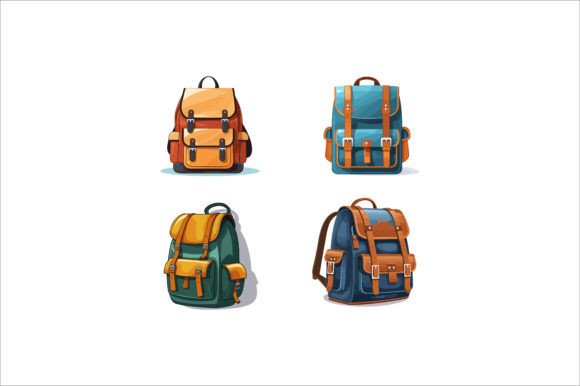
One of the standout features of the school bag vector illustration pack described here is the availability of four different color variants. This is not just about making things look pretty—it is about functionality. Different color backpacks can represent different subjects (e.g., red for math, blue for science), different school levels, or different brands. They can also be used to match a specific brand palette or website theme. With four color options, you avoid the monotony of a single-color icon and gain the ability to create visual hierarchies and contrast in your designs.
Consider a school poster that lists daily schedules. Using a different colored backpack for each grade or subject makes the information easier to scan and more engaging for students. Similarly, in a mobile application, colored backpacks can signal different user profiles or content categories. The combination of color choice and vector scalability makes these assets exceptionally versatile.
Why Choose Vector School Bag Graphics for Your Projects?
If you have ever tried to enlarge a small JPEG image and ended up with a blurry mess, you already know one major reason to choose vectors. But there are other compelling benefits as well:
- Infinite scalability: A vector backpack can be used as a tiny icon on a social media post or blown up to fill a billboard—the quality remains perfect.
- Small file size: Vector files are generally smaller than high-resolution raster images, making them ideal for websites and mobile apps where loading speed matters.
- Editability: In software like Adobe Illustrator, you can change colors, adjust shapes, or add effects to the vector EPS or SVG files without redoing the whole illustration.
- Consistency: Using the same base illustration across all your materials ensures a cohesive visual identity. Whether it is a PNG for a social media graphic or an SVG for a website icon, the artwork stays consistent.
- Cross-platform compatibility: SVG files work seamlessly on the web, while EPS files are standard in print publishing. JPEG and PNG cover the rest of your needs.
These advantages make the school bag vector illustration an excellent investment for anyone who creates educational or promotional content regularly.
10 Powerful Uses for School Bag Vector Illustrations
Now let’s explore the ten specific applications mentioned earlier, with practical examples for each. These use cases demonstrate how a simple backpack graphic can become a core element in diverse projects.
- Educational websites – School bag icons help users navigate e-learning platforms. For example, a colored backpack next to a "Homework" section makes the interface kid-friendly and intuitive.
- School posters – Whether it is a "Welcome Back to School" poster or a "School Supply Drive" announcement, a bright, scalable backpack graphic draws attention and communicates the theme instantly.
- Infographics – In data visualizations about student habits or school statistics, a backpack icon can serve as a recurring visual element that ties the information together. The four color variants can represent different data categories.
- Social media graphics – Platforms like Instagram, Facebook, and Pinterest thrive on visuals. A clean backpack vector works well for posts about school tips, product launches, or seasonal campaigns. The SVG format ensures crisp display on any device.
- Print materials – Flyers, brochures, and newsletters for schools, tutoring centers, or educational nonprofits benefit from high-resolution EPS or PNG files that print beautifully at any size.
- Mobile applications – App developers can use the vector backpack as an icon for the main navigation, a category marker, or a gamification badge. The small file size of SVG helps keep the app light.
- Merchandise – T-shirts, tote bags, notebooks, and stickers often feature bold graphics. A vector illustration is the best starting point because it can be adapted to different merchandise formats and colors.
- Classroom decorations – Teachers can print large backpack cutouts for bulletin boards, name tags, or learning stations. The colored variants make it easy to organize groups or subjects visually.
- Teaching materials – Worksheets, flashcards, and presentation slides become more engaging when they include relatable icons. A backpack graphic can be used to label lesson sections or as a visual cue for "take-home" items.
- Book covers – Whether it is a workbook, a planner, or a children’s story about school, a colorful backpack on the cover immediately signals the theme. The vector format ensures the cover art looks professional and sharp in print.
These ten examples show that the same set of school bag vector illustrations can serve completely different purposes, from digital interfaces to physical products. The key is having the right formats and color options to make each application work smoothly.
Common Misunderstandings About Vector Illustrations (Cleared Up)
Even experienced designers sometimes confuse vector graphics with high-resolution raster images. Let’s clarify a few points to help you make better decisions:
- “SVG and EPS are the same thing.” Not exactly. Both are vector formats, but SVG (Scalable Vector Graphics) is optimized for the web, while EPS (Encapsulated PostScript) is a standard in print and graphic design. Having both gives you the best of both worlds.
- “JPEG and PNG are always inferior to vectors.” Not true. Raster formats like JPEG and PNG are easier to use on social media and in basic office software. They are not scalable, but they are instantly compatible with almost every application. The smart approach is to start with a vector source and export to JPEG/PNG as needed.
- “Vector graphics can’t have realistic textures.” While vectors are inherently flat, modern vector software can simulate gradients, shadows, and textures. The school bag illustrations in this pack are designed to look clean and contemporary without needing photorealistic detail.
Understanding these nuances helps you choose the right file format for each task and avoid frustration when your graphics don't behave as expected.
How to Get the Most Out of Your School Bag Vector Pack
To maximize the value of your four-color, four-format backpack illustration set, consider these practical tips:
- Plan your color coding. Assign each color a specific meaning (e.g., red for urgent, blue for general, green for completed) and use it consistently across your materials.
- Keep the editable files handy. Store the EPS and SVG files in a folder where you can easily access them for future modifications. You never know when you need to change a color or add text.
- Use PNG for quick social media posts. PNG files support transparency, so you can place the backpack on any background without a white box. JPEG is better for photographs or when file size is a concern.
- Test scalability. Before finalizing a large print, test your SVG or EPS file at the intended size to ensure it looks exactly as expected. With vectors, it should be perfect, but it is always wise to verify.
- Stay organized. Name your files clearly (e.g., “school_bag_red.svg”, “school_bag_blue.png”) so you can quickly find the right variant for each project.
The Bigger Picture: How School Bag Vectors Fit Into Modern Education and Design
In today’s digital-first world, visual communication is more important than ever. Teachers are creating their own materials on tablets and laptops. Small businesses are launching educational products. Content creators are building online courses and resources. A school bag vector illustration is a small but meaningful piece of this ecosystem. It is a symbol of learning, organization, and adventure—one that resonates with children, parents, and educators alike.
By using a professional vector pack with multiple colors and formats, you save time, maintain consistency, and present a polished image to your audience. Whether you are a beginner just learning to design your first school poster or an experienced developer integrating icons into a learning management system, these graphics provide a reliable foundation. And because vector technology is built for the future, your assets will remain usable no matter how technology evolves.
Conclusion
School bag vector illustrations with four color options and four file formats (JPEG, PNG, SVG, EPS) are more than just cute pictures—they are practical tools for educators, designers, marketers, and creators. They combine the universal charm of a backpack with the technical power of vector graphics, giving you the freedom to use them in websites, posters, infographics, social media, print materials, mobile apps, merchandise, classroom decorations, teaching resources, and book covers. By understanding the strengths of each format and the value of color variety, you can make informed decisions that elevate your projects and engage your audience.
So the next time you start a back-to-school campaign or develop a learning app, remember the humble backpack vector. With the right set, you have everything you need to carry your visual ideas from concept to completion—in style and at any size.
For more insights on using vector graphics in education and design, explore resources like Adobe Illustrator's vector tools to see how professionals create and edit scalable artwork.